Table of Contents
If 2016 was the year Fake News made its underground debut somewhere in the bowels of the Kremlin, 2017 is the year it went mainstream.
The Brexit crash mat, with promises of extra cash for the NHS and a new dawn of international trade for the UK, has been well and truly kicked from underneath us.
Yet the government insists we are still on course for a soft landing.
And Donald Trump set the tone for his new presidency by boldly disputing photographic evidence that fewer people turned up to witness his inauguration than Obama’s.
“Fake news!” he cried. Once Trump realised he could use the phrase to dismiss any negative media coverage, we heard it every other day.
When Potus is your number one fan, and Collins English Dictionary makes you its word of the year, you know you’ve hit the bigtime.
Fortunately, Fake News is a bit too mainstream for this trendy little corner of the world.
But its lesser-known support act, A Lack of Transparency, certainly won a few fans at the council in 2017.
There was June’s
furtive feastfor former mayor Jules Pipe.
“But how can it be a secret when 400 people turn up?” a council source asked. When no-one tells the media, that’s how.
The notorious Public Space Protection Order (PSPO) made an
under-the-radar returnin October, despite the council scrapping a previous one after accusations that it preyed on homeless people.
Perhaps more significant is the number of complaints from residents last year about the way the Town Hall handled public consultations for demolition jobs on
Holborn Studios, Hackney Road’s
bingo halland the recently refurbished
Britannia Leisure Centre, as well as for the huge Dalston Quarter project.
Responding to views on the latter, the council itself
admitted there was “distrust” over its motivesand unhelpfully vague language in the presentation of its plans.
These consultations are supposed to be a listening exercise, but ‘lacking transparency’ would be a polite summary of how many residents view them.
On a darker note, 2017 was clearly divided into two halves – before and after 14 June.
That was, of course, the day that a fire at Grenfell Tower in Kensington tragically claimed the lives of so many people.
The official death toll stands at 71, though many of those who lived in the block dispute that figure, arguing it is much higher.
It’s fair to say that transparency was in short supply at Kensington and Chelsea Council, both in the run-up and in the aftermath of the blaze, a disaster that naturally led to local authorities across the UK facing intense scrutiny.
The Citizen’s stories have since revealed deep
flaws in the recording of fire risksin Hackney,
delays in addressing experts’ recommendations, and in November forced the borough’s mayor, Philip Glanville, to
apologise for providing misleading fire safety informationto residents – on the day of the Grenfell inferno.
While the council deserves some praise for publishing over 1,800 fire risk assessments since 14 June – many local authorities still keep them under lock and key – it is the surveys that took place in the years leading up to Grenfell that will give a clearer picture of its approach to fire safety.
Unfortunately, the Town Hall is
only publishing new assessments, and has so far refused the Citizen’s repeated requests to release historical FRAs.
Recent housing block fires in Manchester and New York are awful reminders of the potentially life-saving importance of this issue for Hackney residents.
Despite all this, the Mayor went on to
hail the council’s transparency on fire safetyin November.
But it isn’t all bad.
Despite a Town Hall insider describing one of our 2017 print editions as the “Hackney-Council-is-a-crock-of-shit special”, we reported on a number of political positives.
The Town Hall oversaw an
uptick in recycling, introduced new powers to help it tackle the scourge of
rogue landlords, and stood up for residents by campaigning against rising
business rates, swingeing
police cutsand
domestic violence.
And it was at a council briefing in June that community chief Cllr Caroline Selman gave us our
quote of the year.
When asked what powers the council’s enforcement officers can wield, Cllr Selman told the Citizen she didn’t know off the top of her head, but added that their high-visibility jackets do give them a “certain degree of authority”.

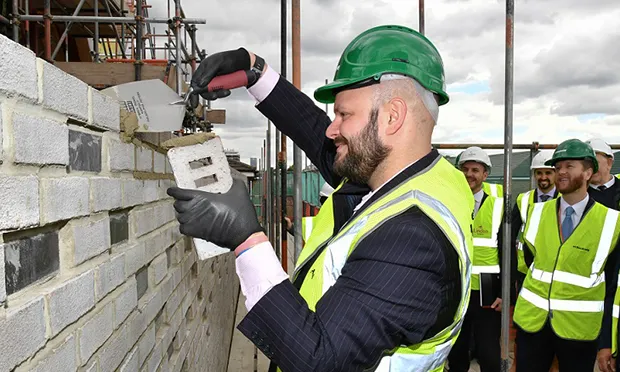
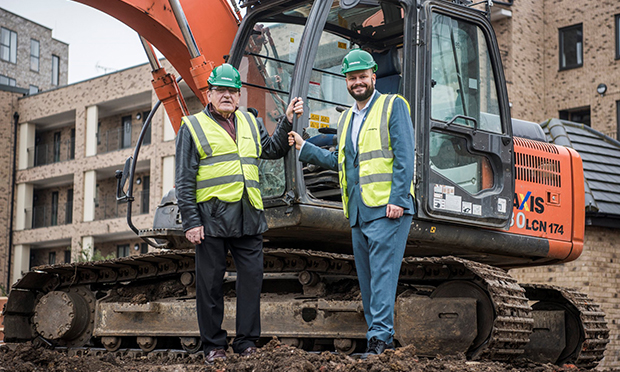
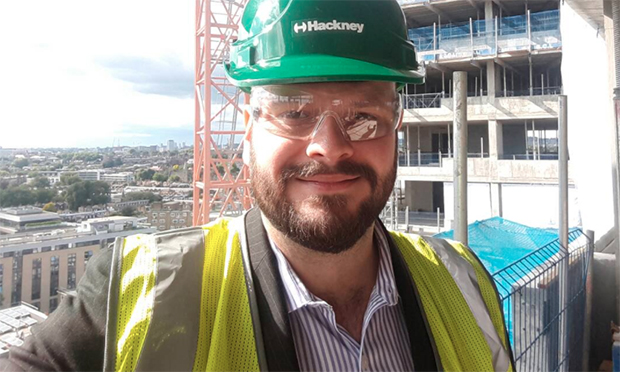
Someone wearing a high-vis jacket could never be accused of lacking transparency, and the fact that Mayor Glanville is often pictured sporting the fluorescent accoutrement is surely no coincidence?
Speaking of the Mayor, who is standing for re-election in 2018, he has kept a key manifesto promise to build more homes in his first full year – the real reason for his luminescent wardrobe – and fronted a drive to show love for Hackney’s
EU nationalsin a borough that remains overwhelmingly Remain.
He has also continued to encourage local businesses to join the council in paying staff the
London Living Wage.
Despite the council’s best efforts, government cuts continue to hamper its effectiveness in certain areas, and this led to a growth in community action in 2017.
Parents and teachers across the borough joined forces in a hard-fought battle to stop further
school cuts.
Divest Hackney kept up its bid to rid the council’s pension fund of
fossil fuel investments.
Local environmental lawyers
ClientEarthwon another court battle against the government in their pursuit to improve air quality across the country.
Residents of Stamford Hill Estate won funding for a
rooftop solar farm.
And a local
gardening collectivetook it upon themselves to start sprucing up Hackney Downs Park.
People across Hackney campaigned admirably on causes close to their heart – Britannia Leisure Centre, Dalston’s Eastern Curve Garden and the just-opened
London Fields Lidoto name just three.
The borough’s various charities also punched above their weight yet again, despite the financially turbulent times.
The
Hackney Winter Night Sheltercelebrated its 25th anniversary, and brain injury not-for-profit
Headway Eastlaid on a both a supper club and an art gallery with great success.
Scores of people answered the call to volunteer at the
Refugee Community Kitchen, and community cookery school
Made in Hackneyraised the money it needed to secure its future.
These are the people who deserve greater transparency from their local politicians.
On a broader scale, though, the fight to reign in Fake News is in hand.
The powerful voices of Barack Obama and the Pope have weighed in on its harmful effects on democracy, and social media companies are starting to act on threats to hold them accountable for the fake stories and anonymous abuse delivered through their platforms.
The cascade of revelations pouring out from the #MeToo campaign, started in the wake of sexual abuse allegations against film producer Harvey Weinstein, also gives hope that greater transparency and authenticity in all walks of life might be just around the corner.
Let’s hope it reaches Hackney, and that the council’s resolution this year is to be a little bit clearer in its communication – honesty goes a long way these days.
If not, at least we can all just slap on some high-vis and muddle our way through another 12 months with a certain degree of authority.
Happy 2018!